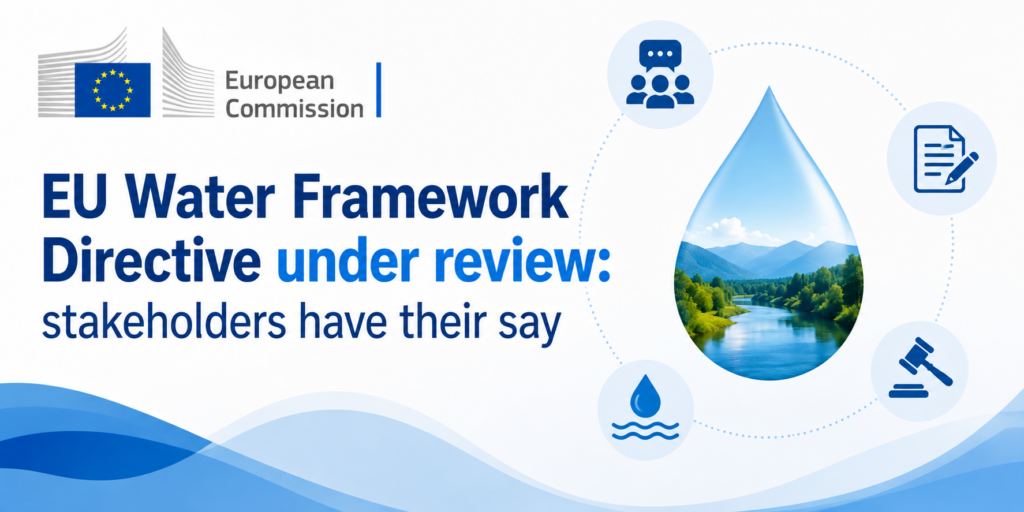
The future of one of Europe’s most important pieces of water legislation is under discussion. On 17 March 2026, the European Commission launched a four-week Call for Evidence on a targeted revision of the Water Framework Directive (WFD), the cornerstone of EU legislation for protecting and improving the status of Europe’s surface waters and groundwater. The consultation closed on 14 April 2026 and attracted more than 3,000 contributions.
The initiative follows the RESourceEU Action Plan and focuses particularly on potential regulatory bottlenecks affecting projects for the extraction, processing and recycling of critical raw materials. The Commission aims to examine how implementation of the WFD could be simplified and made more predictable, while promoting circularity and access to critical raw materials and maintaining high standards of protection for human health and the environment. The Commission has also stressed that any targeted revision should continue to contribute to the objectives of the European Water Resilience Strategy.
A wide range of stakeholder perspectives
The Call for Evidence generated significant interest from citizens and organisations across Europe. Environmental organisations, water-sector representatives, scientific institutions, industry associations, companies and public authorities were among those contributing to the debate.
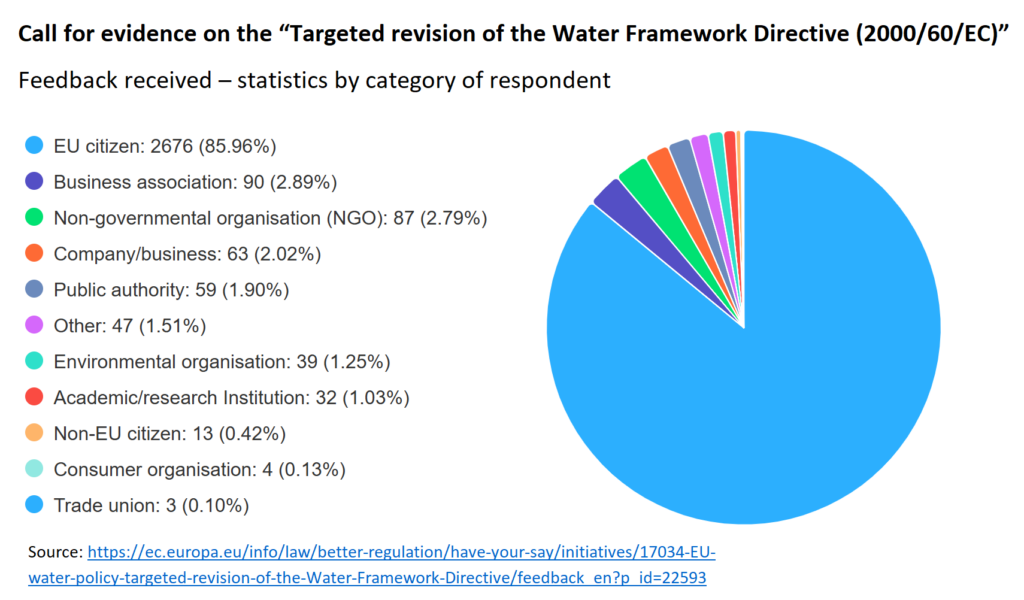
Other stakeholders see scope for a carefully targeted revision. Water Europe, for example, supports a targeted revision while stressing that core environmental standards should be safeguarded and calling for improved permitting, digital and data-driven water governance, and stronger integration of water security into river-basin management. Contributions have also been published by organisations representing water services, energy, industry, science and professional communities, illustrating the breadth of interests affected by the WFD and the challenge of balancing water resilience and ecosystem protection with economic competitiveness, strategic autonomy and the needs of water-dependent sectors.
The feedback submitted through the consultation can be explored directly on the European Commission’s portal: View the Call for Evidence and stakeholder contributions on the Commission’s Have Your Say portal.
Several stakeholders have also made their detailed submissions publicly available, including European Environmental Bureau (EEB), Water Europe, Living Rivers Europe, EurEau, Eurelectric, ClientEarth, European Federation of Geologists (EFG), Confindustria, Aqua Publica Europea and Fortum, among many others.
What happens next?
The Commission described the Call for Evidence as the first step in the targeted revision process. The feedback will contribute to the evidence base for the review and any subsequent legislative proposal, alongside an impact assessment examining economic, social, environmental and territorial impacts. The Commission adoption is planned for the third quarter of 2026.
In parallel, the Commission has already taken steps addressing some of the implementation issues behind the review. On 26 May 2026, it published new Guidance on implementing the WFD when permitting new projects and existing activities, with particular attention to the mining sector. The guidance aims to reduce uncertainty around procedures and assessment criteria and support more harmonised implementation across Member States. The Commission will continue this work with Member States through the WFD Common Implementation Strategy and Structured Water Dialogues.
Water resilience moves higher on the EU agenda
The WFD debate is also unfolding within the broader implementation of the European Water Resilience Strategy. A significant upcoming milestone is the launch of the new Water Resilience Stakeholder Platform on 21 September 2026 in Brussels. The Platform brings together high-level experts from different sectors, Member State representatives and international organisations to advise and support the implementation of the Strategy.
Its first meeting will address the Platform’s future work programme, the Digitalisation Action Plan for the Water Sector, and water efficiency. The Commission will also provide an update on joint guidance for water-efficiency targets. Following the launch, the Platform is expected to meet twice a year, except in years when a Water Resilience Forum takes place. The launch event can also be followed online. Another important development is the preparation of a dedicated Water Resilience Research and Innovation (R&I) Strategy. Importantly, the initiative takes a source-to-sea approach and is being developed in parallel with an Ocean R&I Strategy.
The Commission launched a Call for Evidence for the Water Resilience R&I Strategy on 15 June 2026, inviting researchers, innovators, industry, policymakers, public authorities, NGOs and citizens to help shape future European priorities for water-related research and innovation. The consultation closed on 2 August 2026, attracting 151 contributions, while the Commission adoption is planned for the end of 2026.
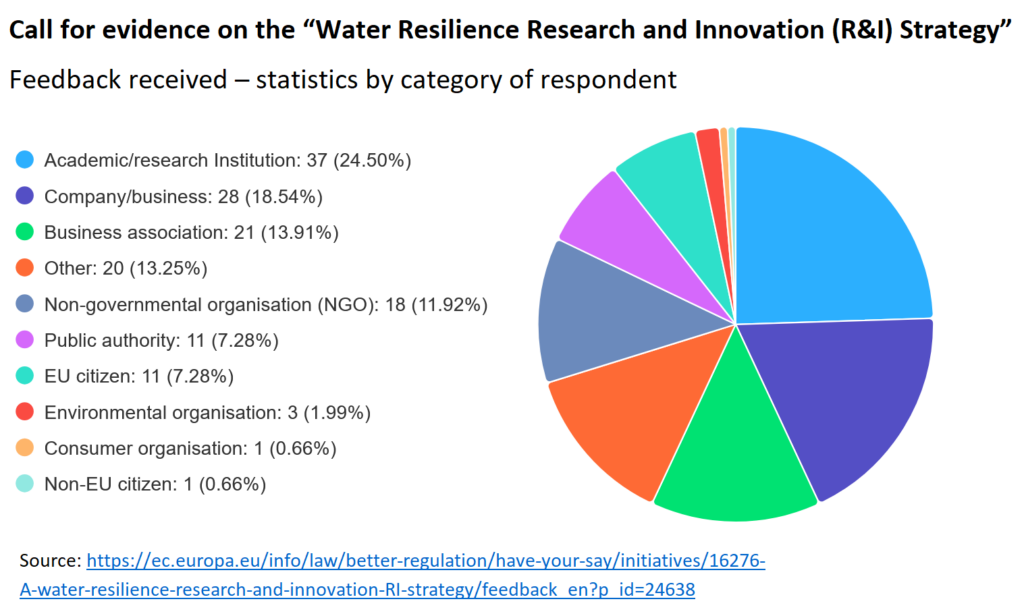
The future R&I Strategy aims to address key knowledge and innovation gaps, improve coordination of water-related research and innovation, support the scaling-up and deployment of existing solutions, and guide future R&I priorities and investment. Topics raised by the Commission include water management and efficiency, Nature-based Solutions, water-efficient technologies, data sharing and artificial intelligence, research infrastructures and testing sites, and stronger links between research, innovation and implementation. The feedback will also help inform strategic R&I priorities under the next EU programming period.
These developments are particularly relevant to STARS4Water, whose work addresses many of the same challenges: strengthening water resilience at river-basin scale, improving the use of data and modelling in water management, and bringing scientific evidence together with stakeholder knowledge and operational realities. As discussions around the WFD and implementation of the Water Resilience Strategy progress, the experience emerging from research projects, river basin authorities and stakeholder communities can provide valuable evidence for shaping the future of European water management.