How can river basin managers prepare for a future in which climate change alters water availability while pressures on water resources and management systems continue to evolve?
STARS4Water has completed an integrated assessment of future water resources availability and risks across its seven River Basin Hubs: the Danube, Drammen, Duero, East Anglia, Messara, Rhine and Seine. The work combines improved climate and hydrological information, modelling tools and locally relevant scenarios to explore how changing conditions could affect water resources and their management across diverse European river basins.The STARS4Water project has released a report on the “Added value of data-driven models and data services”. The report provides an overview of newly developed or improved data-driven modelling tools for assessing future water resources availability in the seven STARS4Water River Basin Hubs, discussing also how the stakeholders supported the process of calibration and validation of the improved model frameworks. The presented case studies address reservoir operation in Drammen, low-flow risks in the Rhine, water allocation in the Danube, groundwater nitrate mapping in the Duero, reservoir forecasting in East Anglia, drought management in the Seine, and water allocation of the overexploited groundwater resources in Messara.
At the heart of the assessment is the STARS4Water Safe Operating Space (SOS) framework, developed together with river basin stakeholders. Rather than applying a single definition of what constitutes a “safe” water system, the framework is tailored to the specific challenges, priorities and operational practices of each basin, helping translate complex information on climate change, hydrological variability and uncertainty into information relevant for water management. Across the seven basins, STARS4Water investigated a diverse range of challenges, including low flows and water allocation in the Danube, hydropower reservoir operations in Drammen, future groundwater resources in the Duero, ecological flows in East Anglia, water stress in Messara, changing river flows in the Rhine, and reservoir operations and low-flow management in the Seine.
The results show that climate change can intensify socioeconomic and environmental risks and challenge existing water-management practices. Scenario analyses also reveal critical situations around water sharing and tensions among different users, which could become more severe under future conditions. These findings highlight the need to consider not only how the climate and hydrological system may change, but also how water is managed and shared among competing uses.
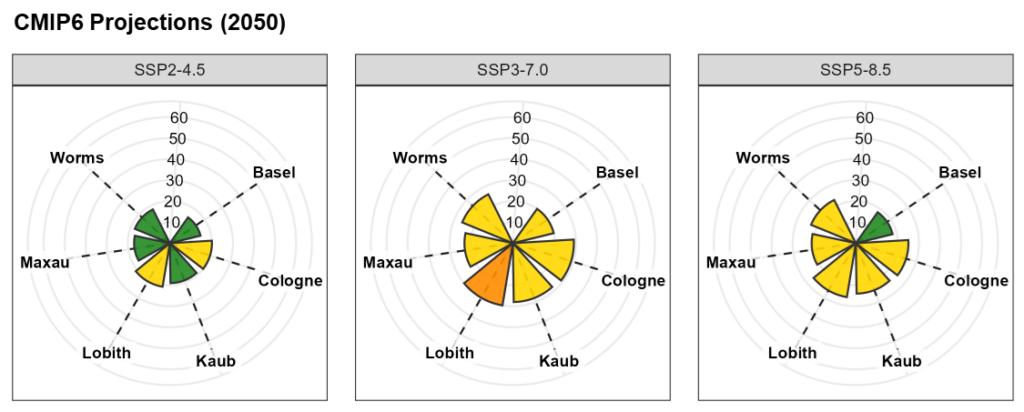
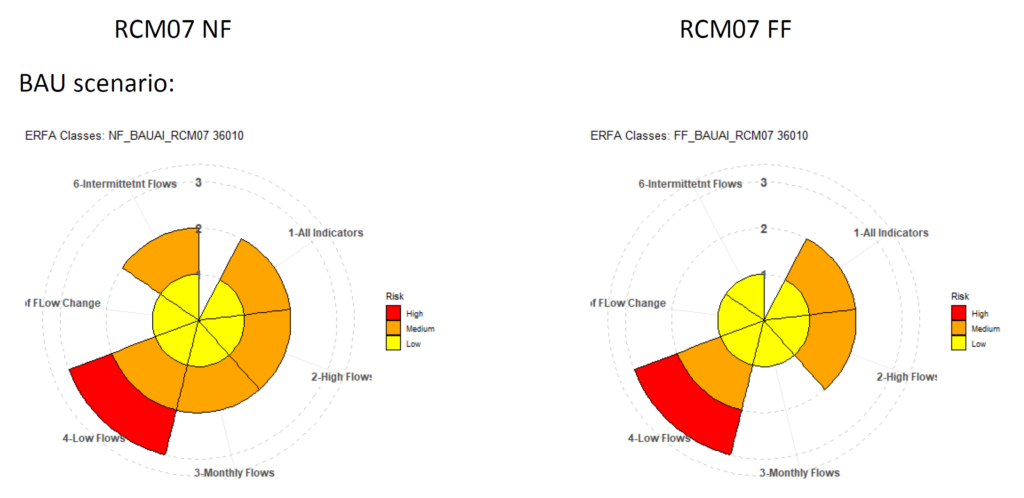
Some example results are demonstrated below:
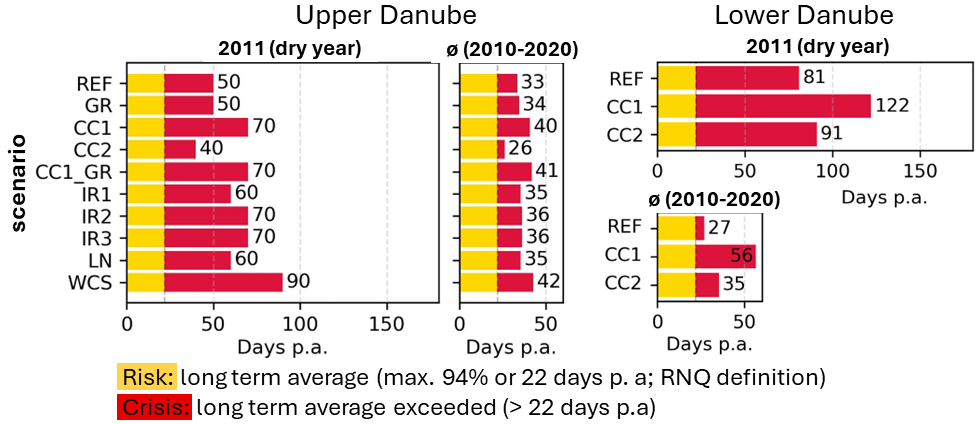
Safe operating space for navigation in the Danube using the indicator ‘number of days per year with discharge at critical stages for navigation’. Left and middle chart shows all considered scenarios and combinations for the Upper Danube. Right column shows the same for the Lower Danube. Results for the average (ø) conditions or for the dry year (2011) are shown.
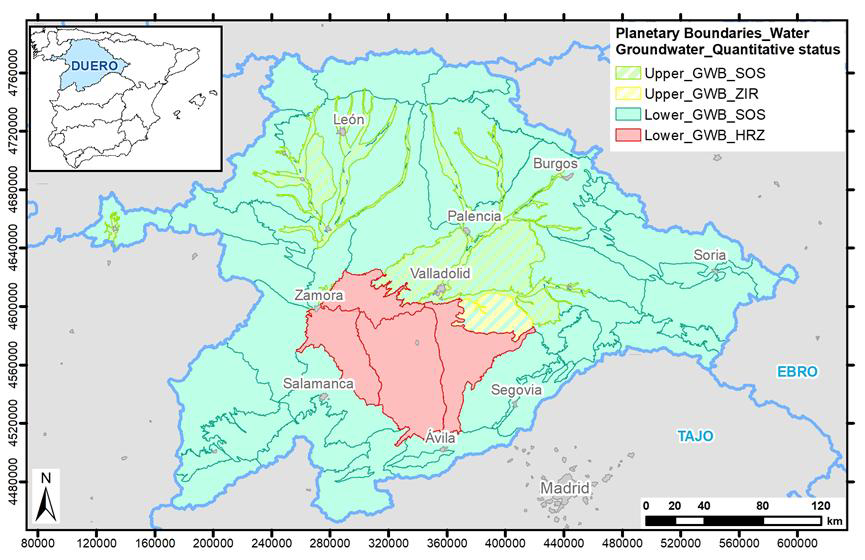
Map of the groundwater quantitative status in the SOS framework of the Duero River Basin, indicating the risk zones of safe operating space (SOS, in green), increasing risk (ZIR, in yellow), and high risk (ZHR or HZR, in red).
A central lesson from the work is the need for an integrated approach to water management that brings together physical factors, socio-economic dimensions and management operations. The involvement of river basin organisations and other stakeholders proved essential for incorporating operational knowledge and management practices into climate-risk assessments and for developing scenarios and indicators that respond to real water-management needs.
The work demonstrates the added value of improved modelling frameworks and data services, as well as the applicability of the Safe Operating Space framework at river-basin scale. Importantly, it also marks a beginning rather than a conclusion: the knowledge, tools and approaches developed through STARS4Water provide a basis for continued dialogue and for supporting the adaptation of water-management practices to future conditions.
The full results are presented in STARS4Water Deliverable 4.2 – Improved projections on water resources availability and risks in selected river basins.
More information can be found in the following STARS4Water project Deliverable: Ramos, M.H. et al. (2026): Improved projections on water resources availability and risks in selected river basins. Deliverable 4.2 (D4.2). Horizon Europe project STARS4Water.