“Developing stakeholder-driven solutions for a water resilient river basin management: Connecting Science to Practice”

15-16th September 2026, Delft, Netherlands

This Conference, organised by the STARS4Water project will bring together river basin authorities, policy makers, scientific institutions, and European actors to reflect on advancing climate-resilient water management across Europe.

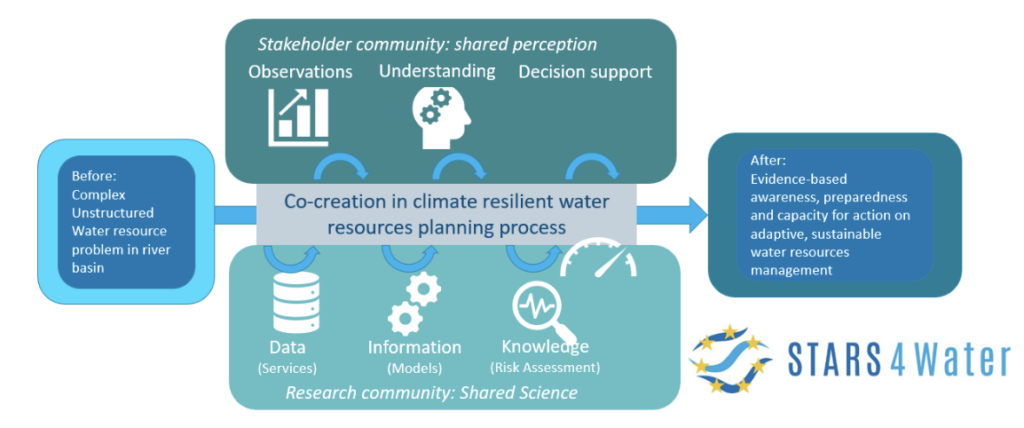
The Conference will focus on the implementation of the EU Water Resilience Strategy, looking into the practical challenges countries and basins face in strengthening preparedness, reducing vulnerability, and building adaptive capacity. A core focus will be on co-creation with stakeholders – demonstrating how linking advanced scientific methods with local knowledge bridges the persistent gap between research communities and basin practitioners. Sessions will illustrate how scientific tools, modelling frameworks, and scenario analyses can be tailored to stakeholder needs through an iterative process, embedded into basin-level decision processes, and used directly by water managers.
A dedicated track will explore the concept of the Safe Operating Space (SOS) for water-resilient management, building on the STARS4Water experience and showcasing how thresholds, risks, and adaptation pathways can be quantified and operationalized in real basin contexts. It will also de demonstrated how new ML/AI technologies can support data harmonization, advanced water resources modeling, and basin-scale planning—featuring a keynote on the transformative potential of AI for water resilience.

A formal agenda will follow. You can register here.
Please save the date and join us in shaping the next steps for water resilience in Europe and beyond.

Outline of the Conference Sessions:

1. Implementation of EU Water Resilience Strategy

The focus of the session is about policy translation and governance alignment- Translating EU-level strategy and targets into basin-level governance, planning instruments, and compliance mechanisms. In short: "How does the EU strategy land in real basin governance systems? "How can EU water resilience objectives be aligned with existing river basin management plans and regulatory frameworks?"

2. Pathways for Resilient Water Management

The focus of this session is about operational, technical, and practice-oriented transformation. “What do basin managers can/should actually do differently on the ground?”

3. The STARS4Water co-creation approach: Co-development of tools and scenarios

This session will focus on the STARS4Water co-creation approach, examining how sustained engagement with river basin stakeholders shaped the design, development and refinement of fit-for-purpose tools and scenarios throughout the project. It will reflect on lessons learned from applying participatory methods to align scientific outputs with stakeholder needs, decision contexts, and capacities at basin level.

4. Scence-Policy collaboration

Following the previous session No.3 that presented the STARS4Water co-development approach, in this session we will broaden the discussion on process, governance, and institutionalization of the co-creation approach. We will discuss how can co-creation be structured as a sustained collaboration process rather than a one-off consultation, and what institutional arrangements, mandates, or incentives enable durable science–policy cooperation at basin level.

5. Unlocking Global data to support local decisions

This session will explore how STARS4Water leveraged global climate, Earth observation, and socio-hydrological datasets and combined them with local observations and stakeholder knowledge to support basin-level analysis and planning. It will reflect on lessons learned in reconciling scale, uncertainty, and data gaps, and on how global data can be made credible, relevant, and usable for local water-management decisions.

6. Role of ML/AI Technologies in water management

This session will present the ML/AI models developed in the S4W project to support basin-level planning and management. It will also address the conditions under which AI-based insights can be made transparent, interpretable, and trustworthy, ensuring they effectively support decision-making by water authorities and policy actors. - In what ways can advanced ML/AI methods support water resources modeling, forecasting, and policy implementation? - How can AI-based insights be made transparent, trustworthy, and actionable for decision-makers?

7. Operationalizing the Safe Operating Space (SOS) in water management

This session will focus on how STARS4Water hubs applied integrated modelling frameworks—such as water-allocation and system-dynamics models (e.g. RIBASIM), climate and demand scenarios, and impact indicators—to define quantitative thresholds for water scarcity, ecological flows, and groundwater stress. It will demonstrate how the SOS concept can be translated into practical decision-support for basin planning, permitting, and adaptive pathways under climate uncertainty.

8. Exploitation of STAR4Water foreground and products

This session will focus on how STARS4Water foreground—including co-developed tools, modelling frameworks, data products, and methodological guidance—can be sustained, transferred, and scaled beyond the project lifetime. It will explore pathways for uptake by river basin authorities, policy institutions, and practitioners, and how STARS4Water results can inform future initiatives, services, and policy processes.

Posters

Poster presentations

Registration Form